
6 Surprising Truths About the Future of Your Cell Tower Lease
1. The Passive Income Myth vs. The New Reality
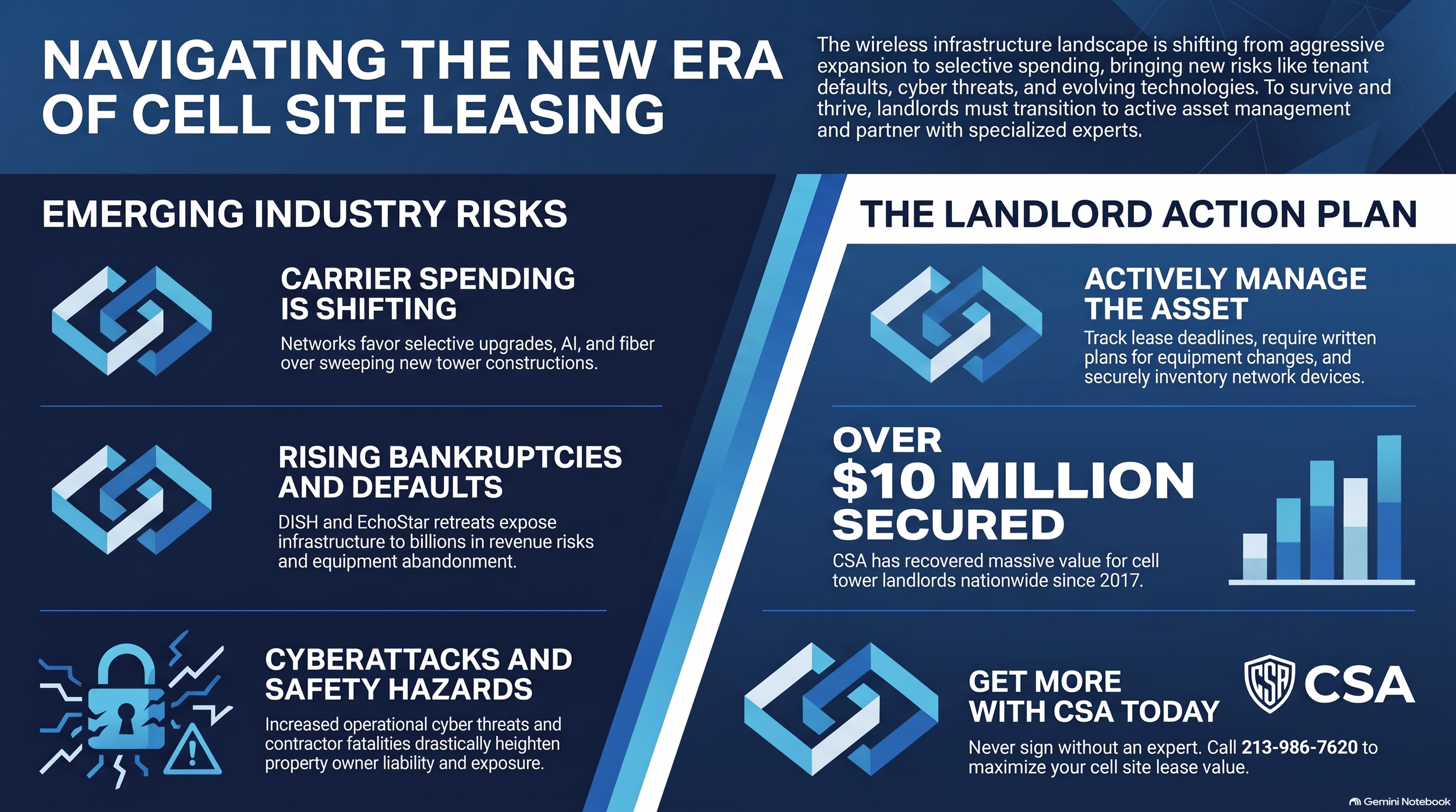
For decades, the industry sold property owners a dream: the cell tower lease was the ultimate "set it and forget it" asset—a reliable stream of passive income that required zero oversight. However, the wireless landscape is shifting beneath your feet. Current industry data reveals that network spending is becoming surgically selective. Carriers are no longer just building more; they are using a sophisticated mix of software, artificial intelligence, and targeted upgrades to squeeze more value out of your property without necessarily offering you a dime more in rent. At Cell Site Appraiser (CSA), we have 30 years of combined wireless leasing knowledge and experience. Since 2017, we have secured over $10 million in value for landlords across the United States. Our mission is to balance the scale between what tower companies know and what landlords need to know. In this new era of "active asset management," your property is no longer a passive check in the mail it is a critical piece of infrastructure that requires expert defense.
2. The "Death of the Tower" Myth: Why Satellites Aren't Your Enemy
There is a loud narrative suggesting that direct-to-device satellite services, like SpaceX’s Starlink, will soon make terrestrial cell towers obsolete. The data tells a very different story. Satellite and terrestrial networks are not competitors; they are complements. While satellites are excellent for emergency "dead zone" coverage, they lack the capacity to handle the data-heavy demands of modern life."Terrestrial sites remain better suited to repeated, high-capacity use in populated areas."Terrestrial sites are essential for indoor signal penetration and high-volume data traffic things a satellite 300 miles in orbit simply cannot do effectively. Expert Warning: Expect your tenant to weaponize satellite headlines to manufacture a sense of "obsolescence" during your next rent negotiation. They may use these claims to pressure you into rent reductions or unfavorable buyout terms. Treat any claim that "satellites are replacing towers" as a negotiation tactic that requires rigorous evidence, not an industry fact.
3. The Invisible Upgrade: How AI is Changing Your Site Without a Single Bolt
Artificial Intelligence is already being deployed to overhaul how your cell site operates, and it’s happening without a single construction crew appearing on your property. T-Mobile and Ericsson recently proved that an AI-based scheduler can increase spectrum efficiency by 10% through a software-only update on "AI-ready" equipment. This creates a hidden risk for landlords. Carriers often use "like-for-like" replacement clauses or "routine maintenance" language to hide the fact that they are significantly increasing the site’s productivity and value. By claiming it is a software-only fix, they attempt to dodge the "added compensation" typically required for physical expansions or site upgrades. Landlord Action: To protect your interests, you must maintain a "current inventory" of every antenna, radio, and cabinet on your site. Do not take the tenant's word that a project is "routine." A software upgrade often requires increased physical compute power or new cooling systems. If they are sneaking in new hardware under the guise of maintenance, you are missing out on a relocation or amendment fee.
4. The SpaceX Plot Twist: It’s Not Just in the Sky
While the headlines focus on the sky, SpaceX is quietly moving into your backyard. The company is planning a terrestrial network built around small cellular radios placed near Starlink ground equipment. Proving their seriousness, SpaceX recently acquired 65 MHz of spectrum from EchoStar—a massive move that signals their intent to compete on the ground. For rural landlords, this creates a fresh wave of demand for ground space, fiber routes, and power equipment. However, the risk is high: many landlords may accept a small, low-rent installation from a new entrant like SpaceX without realizing they are providing the anchor for a major future network. LANDLORD ACTION TIP: Do not approve any installation from a new entrant until the agreement strictly defines the equipment, specific frequencies, and expansion rights. Every small equipment request should be treated as a high-value infrastructure project. If you don't define the frequencies and power now, you lose your leverage when they expand later.
5. The DISH Default: When a Big Name Becomes a Big Risk
The financial turmoil surrounding DISH and EchoStar has sent shockwaves through the industry. With approximately $9 billion in contracted tower revenue at risk, many ground landlords are sitting on a ticking time bomb. DISH’s bankruptcy filings have already listed major tower and infrastructure companies as "creditors with contingent, unliquidated, or disputed claims," meaning the money you expect for removal or rent could be frozen in a legal vacuum. Even if you don't lease directly to DISH, a default can trigger "dark" sites—where equipment sits abandoned on your property while the legal battle over removal costs rages. "DISH-related defaults and EchoStar’s spectrum exit have exposed tower and infrastructure companies to disputed claims and removal costs." Landlord Audit Steps:
Check the Document Chain: Review assignments and revenue-share clauses to see how deep your exposure goes.
Verify Removal Obligations: Confirm who is legally responsible for cleanup if the tenant exits.
Audit for "Dark" Sites: Conduct a physical inspection. Is the equipment active, or has it been abandoned? Identifying a "dark" site early is the only way to protect your property from being a graveyard for old hardware.
6. The New Front Line: Why Your Cell Tower is a Cybersecurity Target
Cell sites are no longer just about phone calls; they are the front lines of international conflict. Recent coordinated cyberattacks by Iran-linked hackers targeted utility sites in Minnesota, specifically hitting equipment connected to water towers and lift stations. Because many cell sites are hosted on municipal water towers or shared utility buildings, a breach in a tenant’s cabinet or a shared network connection can compromise the landlord's entire operation. You face massive legal and operational liability if a tenant’s lack of security allows a hacker to access your building’s control systems. Landlord Action: Three Steps to Separate Your Networks
Inventory Every Connection: Identify every network-connected device on your property and confirm who owns the data path.
Separate and Patch: Ensure your operational networks (utilities, security) are completely isolated from tenant networks. Patch all supported equipment and maintain offline backups of critical systems.
Strict Access Control: Change all default credentials on shared equipment and restrict remote access to your systems.
7. Conclusion: Knowledge is Your Only Leverage
The era of the "passive" cell tower lease is over. Carrier spending is tighter, and their tactics for extracting value from your land are getting smarter. "Active asset management" is no longer optional—it is the only way to defend the value of your property. At CSA, we live by a simple principle: Knowledge is power! When you know more, you get more. Whether you are facing a lease renewal, a suspicious amendment request, or a buyout offer, do not sign a single document until you have the data to prove what your site is truly worth to the carrier’s network. Contact Cell Site Appraiser Today:
Website: cellsiteappraiser.com
Phone: 213-986-7620
Final Thought: Is your property just a point on a map to your tenant, or do you have the data to prove it’s the backbone of their local network?
Editorial Note: This report summarizes publicly available information from business news outlets, financial analyst reports, industry trade publications, and federal court filings. All claims are attributed to their original sources and cited throughout. The analysis represents the author's professional interpretation of these publicly available materials and constitutes commentary and opinion on industry developments. Property owners are encouraged to review the original cited sources independently and consult qualified legal and financial advisors before making decisions regarding their lease agreements.