
The Invisible Land Grab: Weaponizing RF Compliance to Protect Your Rooftop Asset Value
For most property owners, a rooftop cell site is treated as the ultimate "passive" income stream—a steady check for equipment that sits high above, out of sight and out of mind. However, beneath the surface of these lease agreements, a complex regulatory and spatial battle is taking place for the "compliance envelope" of your building. What appears to be a static installation is frequently a predatory environment where wireless carriers expand their control and liability footprint without the landlord's knowledge. At Cell Site Appraiser (CSA) , our mission is to balance the scale between what tower companies know and what landlords need to know. Since 2017, we have secured over $10 Million in value for landlords by treating these installations not as passive checks, but as high-stakes risk management projects.
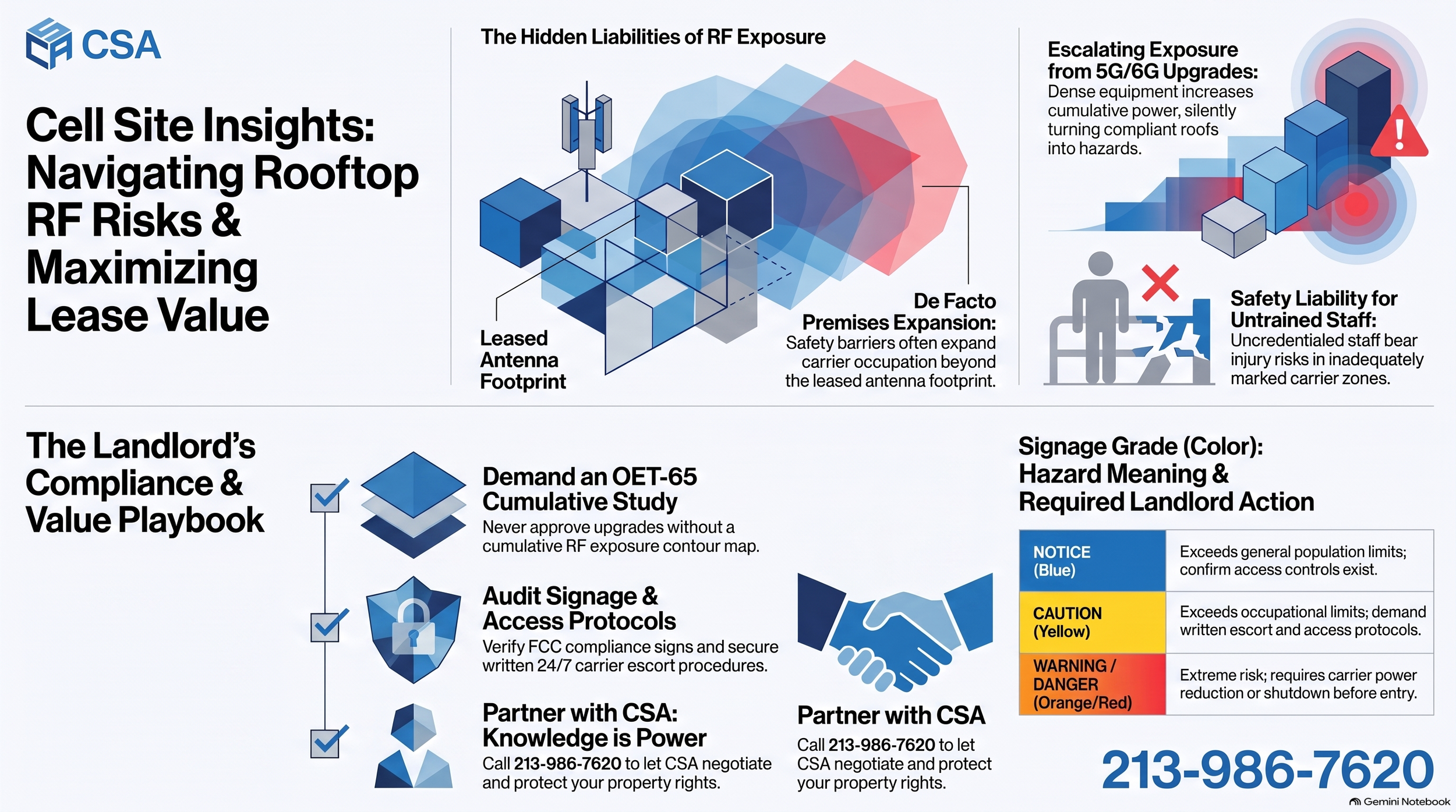
The Invisible Space Grab: Identifying De Facto Premises Expansion
In the majority of telecom leases, the "Equipment Area" is strictly defined by a specific square footage or exhibit. However, carriers are increasingly engaging in De Facto Premises Expansion . This occurs when the carrier’s required RF-controlled barriers , locked access points, and caution signage extend well beyond the boundaries of the leased premises.When a carrier places a barrier or restricts access to a portion of the roof that is not part of their rented square footage, they are effectively seizing control of property they haven't paid for. From a Risk Architect’s perspective, this is a contractual breach of your "compliance-with-law" and "maintenance obligation" clauses. Carriers are functionally taking exclusive possession of your rooftop, interfering with your duty to maintain the building, and increasing your insurance profile—all while paying for the same 200-square-foot footprint they had ten years ago."DO NOT AGREE TO SIGN anything unless you have CSA on your side."
The Two-Tiered Safety Trap: Quantifying the Liability to Your Staff
The Federal Communications Commission (FCC) regulates human exposure to radiofrequency (RF) fields under 47 C.F.R. §§ 1.1307 and 1.1310 , establishing two distinct exposure ceilings that determine your legal liability.
Occupational/Controlled Exposure (20 mW/cm²): This higher limit applies only to personnel who have received documented RF safety training (typically the carrier’s own techs).
General Population/Uncontrolled Exposure (4 mW/cm²): This limit applies to your building engineers, roofers, HVAC vendors, and inspectors.Crucial Fact: The general population exposure limit is exactly one-fifth of the occupational limit. A common misconception is that a locked door makes an area "controlled." Under FCC rules, if your staff has not received documented training, they remain "general population" subjects regardless of locks. If a carrier’s equipment produces power density above 4 mW/cm² in an area where your untrained staff must walk, you are sitting on a massive safety violation.
The 5G/6G Paradox: Why New Tech Equals Expanded Risk
Property owners often assume that as technology improves, equipment becomes smaller and safer. The reality is the opposite. The move toward 5G and 6G utilizes higher-frequency spectrum that attenuates faster over distance. To maintain signal integrity, carriers must use more antennas, more sectors, and significantly higher power density .This tech evolution triggered a September 17, 2026 , FCC rulemaking update, revisiting the agency's previous conclusion that no changes to exposure rules were warranted. As carriers densify for 6G, the invisible "compliance zones" are expanding. A rooftop that was compliant two years ago could silently become a non-compliant liability today, turning a safe walking surface into a restricted RF zone overnight.
The 5% Rule of Shared Guilt: Breaking the "Summation Method"
RF compliance is a cumulative calculation known as the Summation Method . At every point on your roof, the individual percentage contribution of every transmitter (AT&T, Verizon, T-Mobile, etc.) is added together. If the total exceeds the 100% Rule , the site is non-compliant.The 5% Rule: If a site exceeds the 100% threshold, the FCC assigns mitigation responsibility to any licensee contributing more than 5% to the aggregate exposure. This is a vital piece of leverage for landlords. This rule prevents a fourth or fifth carrier from "free-riding" on the safety margins left by earlier tenants. Because ground-reflection effects can increase power density by up to 6 dB (doubling the field strength), you must demand a per-transmitter percentage breakdown . Do not accept a generic "site is compliant" letter; you need to know exactly who is pushing the site toward a violation so you can force them to pay for remediation.
Your Signature is Your Only Leverage: Weaponizing the Consent Form
Carriers treat equipment modification and co-location consent forms as "routine paperwork." In reality, this is the only moment you hold the leverage to audit the entire site. Never sign an upgrade consent without an updated, independent OET Bulletin 65-consistent exposure study that maps the proposed configuration, not just the existing one.If the new equipment expands the "Category Two" (Notice) or "Category Three" (Caution) footprint beyond the lease exhibit, you are no longer dealing with a routine upgrade—you are dealing with an expansion of the leased premises. Furthermore, for sites in California, check CPUC General Order 159A status. Operating past permit expiration or failing to file proper notification is a daily-accruing violation with penalties ranging from $500 to $50,000 per day under PUC §§ 2107–2108. This financial exposure is the ultimate "stick" to ensure carriers stay within their boundaries."CSA analysis represents our professional interpretation of these publicly available materials and constitutes commentary and opinion on industry developments."
Summary: Is Your Asset Expanding in the Dark?
Active management is the only way to protect your property rights. By mapping exposure contours against your lease exhibits, identifying De Facto Premises Expansion , and auditing signage against the FCC's five-element standard, you move from a passive recipient of rent to an active architect of asset value. Is your rooftop truly a passive asset, or is it a liability expanding in the dark? Since 2017, CSA has balanced the scale for property owners, recovering millions in value by refusing to treat telecom carriers as "standard" tenants.
Visit cellsiteappraiser.com or call 213-986-7620 to secure your property’s value today.