
Are Satellites Making Cell Towers Obsolete? 5 Counter-Intuitive Truths Every Property Owner Must Know

1. Introduction & Hook
Headlines about low-Earth orbit satellites—from SpaceX’s Starlink Mobile initiatives to joint carrier direct-to-cell ventures—are filling tech feeds daily. For cell site landlords, these announcements frequently stir panic: is satellite technology about to render terrestrial ground towers obsolete, erasing property value and wiping out rental streams overnight?
Despite media fanfare, the reality on the ground tells a vastly different story. National wireless carriers, telecommunications analysts, and SEC filings confirm that physical ground sites remain the non-negotiable anchor of modern communication networks.
To help property owners see through carrier negotiation tactics, we have distilled five counter-intuitive, high-impact takeaways from recent corporate litigation, FCC proceedings, and Wall Street equity research. Understanding these commercial dynamics will protect your underlying fee interest and ensure national tech headlines don't erode your financial leverage.
2. Takeaway 1: Satellites Are Complementary, Not Substitutes (The Coverage vs. Capacity Gap)
Media coverage, including reports from Reuters, recently highlighted that SpaceX agreed to a proposed acquisition of a nationwide low-band (800 MHz) spectrum portfolio for Starlink Mobile. Simultaneously, AT&T, T-Mobile, and Verizon announced a joint venture—headed by interim CEO Paul Roth—aimed at expanding satellite connectivity across remote, underserved regions.
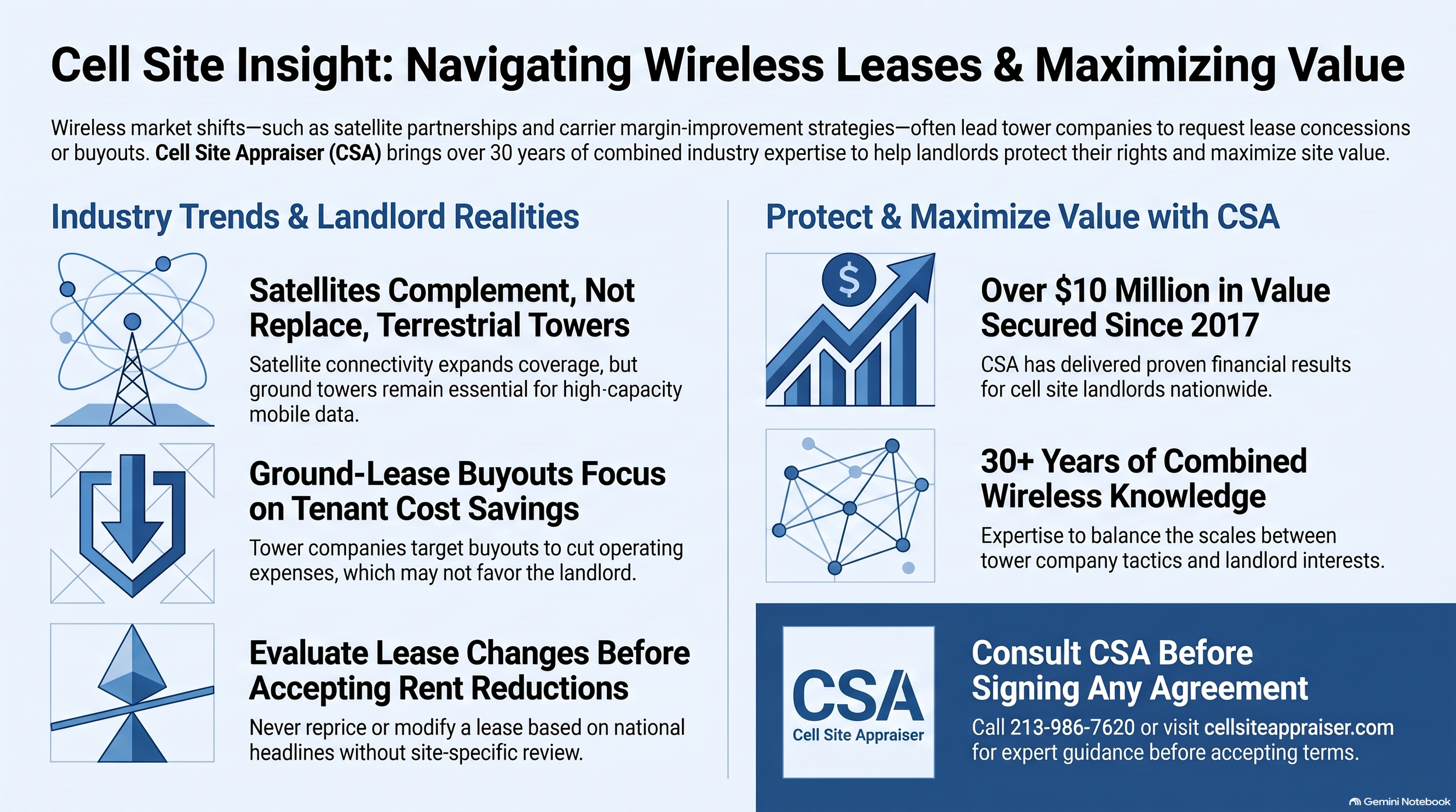
While these moves sound transformative, industry analysis from Strand Consult (published via Wireless Estimator) emphasizes a fundamental engineering reality: the distinction between direct-to-cell satellite coverage and macro-cell site density. Satellites are uniquely suited for coverage—reaching broad, sparsely populated, or geographically challenging areas. However, terrestrial cell towers are absolute necessities for capacity—delivering high data volumes to concentrated populations. In fact, SpaceX’s proposed spectrum transaction is far from proof of a deployed, fully operational nationwide mobile network; rather, it reflects a long-term strategy that may ultimately require ground-based infrastructure to function effectively.
When a tenant or lease optimization consultant cites "satellite competition" to demand a rent reduction, recognize it as a tactics-driven bluff. As Strand Consult's analysis demonstrates, satellite partnerships complement terrestrial architecture rather than eliminate the physical land beneath the tower.
"Satellite connectivity is changing the wireless industry’s competitive debate, but it is not evidence that an existing tower has become unnecessary... The distinction is between coverage—getting a signal to a location—and capacity—serving many people using substantial amounts of data."
3. Takeaway 2: Tower Companies Are Eyeing Your Lease to Boost Their Own Margins
When tower aggregators or site operators reach out with lump-sum lease buyout offers, they frame the transaction as a risk-mitigation opportunity for the landlord. However, coverage from MarketBeat regarding Crown Castle management reveals the real corporate driver: ground-lease buyouts are a key margin-improvement initiative designed to slash ongoing occupancy costs.
There is a crucial strategic connection here: MarketBeat noted management’s expectation that upcoming spectrum rollouts and surging mobile data growth will drive future tower leasing demand. Tower operators aggressively push for ground-lease buyouts precisely when they anticipate new spectrum deployments that will make the physical ground rights significantly more lucrative. Accepting an early buyout surrenders your underlying fee interest, stripping you of annual escalation compounding, long-term recurring yield, and future property redevelopment flexibility.
Before entertaining a lump-sum offer, evaluate the true lifetime value of your real estate against the operator's margin-expansion targets:
Escalation Compounding: Contrast the discounted lump-sum payout against the exponential, compounding growth of annual rent increases over a multi-decade horizon.
Easement Scope & Duration: Examine the exact legal burden, term length, and environmental or structural indemnities tied to any proposed permanent easement grant.
Access & Property Rights: Audit surrendered rights regarding site ingress/egress, co-location revenue sharing, land exclusivity, and future site redevelopment restrictions.
Tax Consequences: Evaluate the immediate tax impact of a single cash payout versus the tax-advantaged income stream of recurring rental payments.
4. Takeaway 3: Wall Street Loves Long-Term Rental Contracts—And So Should You
While tower management teams frequently request lease concessions or threaten site decommissioning when negotiating with property owners, their executive presentations to Wall Street reveal a completely different financial narrative. Recent analyst commentary from Zacks regarding American Tower highlights how institutional investors assign premium stock valuations based on predictable recurring revenue, long-term carrier lease contracts, network expansion capital, and data-center integrations like CoreSite.
This creates a glaring industry paradox. Tower companies actively attempt to drive down ground lease expenses, even though their own multi-billion-dollar enterprise valuations depend fundamentally on the durability and length of their real estate contracts.
As a property owner, you must recognize that your signed ground contract sits at the foundation of these institutional valuations. You hold the underlying physical asset that secures corporate balance sheets.
What Tower Companies Tell Landlords vs. What They Tell Wall Street
To Landlords: "Technology is shifting rapidly, satellite networks threaten tower longevity, and you should lock in a reduced rent or accept a discounted lump-sum buyout today."
To Wall Street: "Our business model is underpinned by highly predictable, long-term rental contracts, steady escalation compounding, and durable recurring lease cash flows."
5. Takeaway 4: Corporate Headlines Don't Change Your Lease (The DISH Legal Saga)
Sensational headlines involving carrier litigation, restructuring, or corporate defaults frequently make national news. However, savvy real estate owners must look past high-level media reports and analyze entity-level contractual realities. A case in point is Crown Castle’s high-profile legal dispute with DISH Wireless, where Crown Castle asserted a contractual default claim exceeding $3.5 billion following agreement termination.
The Headline
Media outlets report multi-billion-dollar bankruptcy filings, litigation stays, and severe financial restructuring across the broader DISH corporate umbrella.
The Reality for Landlords
It is vital to distinguish between corporate entities. Published legal reporting from Law360 demonstrates that bankruptcy proceedings involving television entities like DISH DBS do not automatically govern or terminate the distinct ground lease obligations of DISH Wireless. Furthermore, Crown Castle’s $3.5 billion assertion is merely an asserted contractual default claim subject to active bankruptcy litigation stays—not a finalized court judgment or cash recovery. Most importantly, a tower operator's third-party dispute with a subtenant carrier does not suspend or relieve its direct legal duty to pay ground rent to you, the landowner.
Property owners must verify the precise legal entity listed on their lease contract and maintain meticulous payment records. Inter-corporate litigation does not modify executed lease obligations.
6. Takeaway 5: Regulatory & Trade Announcements Are Not Contractual Obligations
Federal rule adjustments, trade association updates, and policy headlines are routinely weaponized during lease negotiations. For instance, the Wireless Infrastructure Association (WIA) recently named American Tower executive Rich Rossi as board chair, while the FCC advanced proceedings on Upper C-band relocation costs (analyzed by Wiley) and environmental review rules (reported by Broadcast Law Blog).
Landlords must carefully dissect these public statements. When carriers mention regulatory updates, they often try to pass off broad administrative policy shifts as automatic rights to expand equipment footprints without landlord consent. In reality, legal commentary from Broadcast Law Blog confirms that the FCC's updated environmental rules applied specifically to a narrower review framework for broadcast construction tied to Antenna Structure Registration (ASR) and historic preservation—it explicitly does not establish a blanket exemption from environmental review for wireless towers under 200 feet.
Always separate public trade rhetoric from binding private real estate agreements:
Industry Advocacy: Board appointments and public policy positions from trade organizations like the WIA reflect strategic lobbying for tower operators—they carry zero force of real estate law.
Binding Lease Contract: Your executed ground lease contract governs physical boundaries, structural load permissions, compensation terms, and site modifications on your property.
If a tenant asserts that an FCC ruling or spectrum reallocation mandates site modifications, require full site-specific engineering plans—including cabinet placements, power draws, line runs, and structural analyses—to confirm explicit contractual authorization before granting property access.
7. Conclusion & Final Thought-Provoking Takeaway
Macro-industry evolutions—whether direct-to-cell satellite launches, trade group leadership shifts, FCC regulatory notices, or corporate balance sheet restructurings—do not rewrite an executed real estate contract. Terrestrial tower infrastructure remains irreplaceable for urban and suburban mobile capacity, keeping your physical land firmly embedded at the core of wireless infrastructure value.
When evaluating your site's future, are you letting national technology headlines and corporate negotiation tactics dictate the true commercial worth of the land beneath the tower?
"Knowledge is power when it comes to cell site leasing."